




Water Damage Restoration in Huntington Beach, CA
24/7 Emergency Response: (951) 579-4096 Superior Restoration serves Huntington Beach from our Anaheim office at 1260 South Simpson Circle, 15 miles northeast via Beach Boulevard or the 405. Our IICRC-certified technicians reach Surf City emergencies in 20 to 25 minutes with truck-mounted extraction equipment and commercial drying systems. We restore water-damaged homes and businesses across Orange County’s coastline, where salt air, high water tables, and tidal influence create water damage conditions you won’t find inland.Why Huntington Beach Has Unique Water Damage Risks
Water damage restoration in the City of Huntington Beach requires understanding how 9.5 miles of coastline, a man-made harbor, and major river systems converge to create elevated moisture conditions across the entire city. This is not a typical inland restoration market. The water table is close to the surface near the coast, salt air corrodes plumbing faster, and some neighborhoods sit at elevations barely above sea level.The Santa Ana River and Coastal Flood Risk
The Santa Ana River — the longest river in Southern California — empties into the Pacific Ocean at the northern boundary of Huntington Beach. During the catastrophic 1969 floods, the river breached its banks and sent water through neighborhoods between Brookhurst and Newland Street. Modern flood control infrastructure has improved the situation, but the underlying geography has not changed. Properties near the river mouth and along the Huntington Beach Wetlands remain in FEMA flood zones. The February 2024 atmospheric river events pushed the Santa Ana River to its highest levels in years. Properties in the Huntington Harbour area and along the Pacific Coast Highway corridor dealt with elevated groundwater that turned minor plumbing leaks into major water damage events. When the water table rises, even small amounts of water from internal sources cannot drain away from the building.Huntington Harbour — Waterfront Living, Waterfront Problems
Huntington Harbour is a man-made harbor community built in the 1960s and early 1970s. Homes along the harbor channels face tidal influence, salt water spray, and a water table that fluctuates with ocean conditions. King tides push water into low-lying areas along the channels, particularly near Warner Avenue and Davenport Drive. The homes themselves — now 50 to 60 years old — have plumbing that has been subjected to salt-laden air and moisture their entire service life. Copper corrodes faster in coastal environments. Fittings deteriorate. Supply lines that might last 50 years inland fail at 35 near the harbor.Beach Cottages and Coastal Elevation
The neighborhoods near the pier — Downtown Huntington Beach, Main Street, and the Bolsa Chica Mesa — include beach cottages and bungalows from the 1920s through 1950s. Some of these homes sit on raised foundations with crawl spaces that accumulate moisture during high water table events and king tides. Others sit directly on slabs at elevations barely above sea level. Original plumbing in these homes ranges from 70 to 100 years old. Galvanized supply lines, clay sewer laterals, and building materials that have absorbed decades of coastal moisture.Salt Air Corrosion
Salt-laden marine air accelerates corrosion on every metal component in a Huntington Beach home. Plumbing fittings, water heater anode rods, HVAC components, and even the nails and fasteners holding the structure together deteriorate faster than identical components in an inland city. This means shorter lifespans for everything water-related and a higher frequency of the kind of sudden failures that cause water damage.Common Water Damage Causes in Huntington Beach
Plumbing Failures in Harbour and Coastal Homes
Huntington Harbour homes and the beach-adjacent cottages near PCH have the highest plumbing failure rate of any Huntington Beach neighborhood. Salt air corrosion, tidal moisture cycling, and original 1960s-era plumbing create a predictable failure timeline. Copper supply lines develop pinhole leaks at solder joints. Cast iron drain stacks crack at the floor line where condensation accumulates. Water heaters in these homes should be inspected at 6 years and replaced by 8 — shorter than the standard 10 to 12-year replacement cycle.Groundwater Intrusion During King Tides
King tides occur several times a year when gravitational alignment pushes ocean levels above normal high tide marks. In Huntington Beach, this means groundwater rises across the coastal neighborhoods. Homes with crawl spaces near the Harbour, the Bolsa Chica Wetlands, and the neighborhoods south of Adams Avenue can see moisture levels in their crawl spaces spike during these events. The moisture migrates upward through foundation materials, saturating subflooring and creating conditions for mold growth — even without a single pipe failing.Storm Surge and Coastal Flooding
Major Pacific storms combine high surf, elevated tides, and heavy rainfall simultaneously. The December 2023 high surf event sent waves over the seawall near the pier, flooding portions of Pacific Coast Highway and pushing water into ground-floor commercial spaces and parking structures. Homes on the oceanfront between Goldenwest Street and Beach Boulevard face direct exposure during these events.Roof Leaks in Older Neighborhoods
Flat and low-slope roofs are common on Huntington Beach’s mid-century homes. Salt air deteriorates roofing materials faster than in inland locations. Flashing corrodes, underlayment breaks down, and the 10 to 15 heavy rain events per year find every weak point. The Goldenwest, Edwards Hill, and Pacific Ranch neighborhoods from the 1960s and 1970s have the concentration of aging flat roofs that generate the most ceiling leak calls during winter storms.Our Water Damage Restoration Process for Huntington Beach
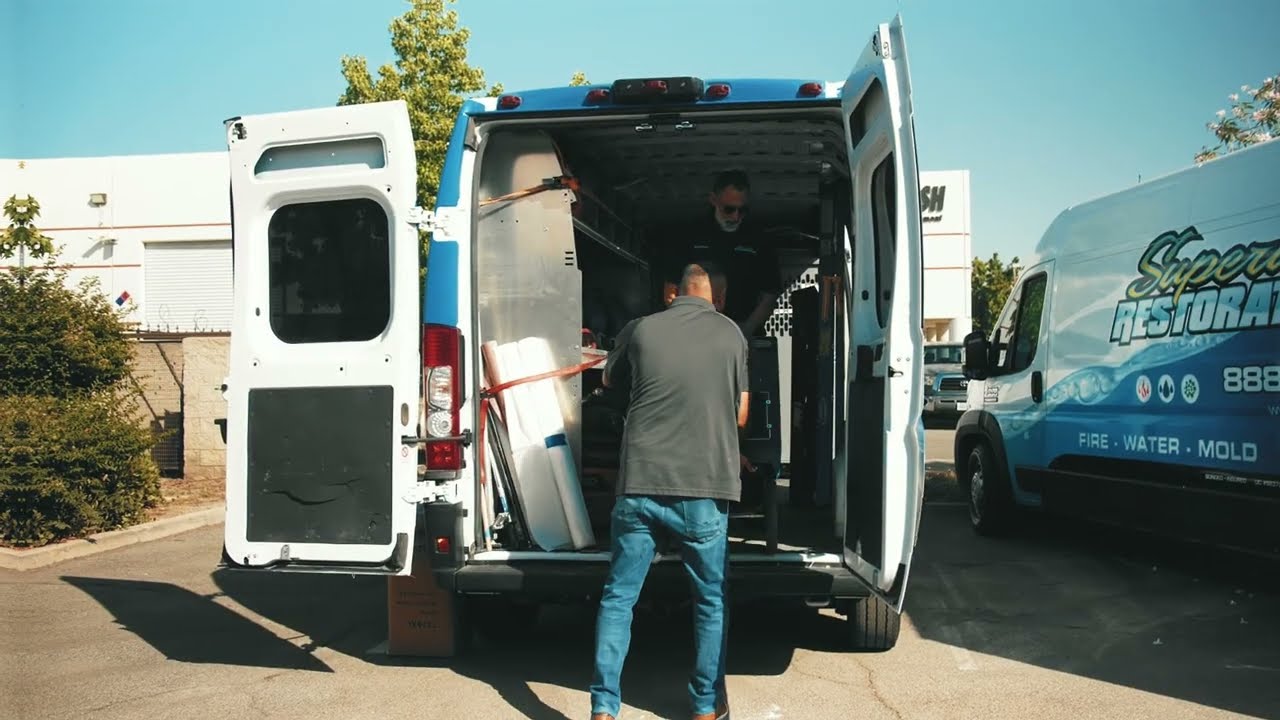
Call (951) 579-4096. Our Anaheim office at 1260 South Simpson Circle is 15 miles from central Huntington Beach. Response time runs 20 to 25 minutes via Beach Boulevard or the 405. For emergencies along PCH or in the Harbour, we are typically on-site within 25 minutes. Assessment: Thermal imaging and moisture meters map the full extent of intrusion. In coastal Huntington Beach, we assess for both the immediate water source and for groundwater contribution — the high water table can compound damage from above with moisture from below. Water Extraction: Truck-mounted extractors remove standing water. For homes with crawl spaces affected by tidal or groundwater intrusion, we deploy submersible pumps to address below-grade water before treating the living spaces above. Structural Drying: Commercial air movers and dehumidifiers bring materials to target moisture content. Huntington Beach’s coastal humidity means drying requires significantly more dehumidification capacity than inland jobs. We monitor daily with moisture readings and adjust equipment placement as drying progresses. Cleaning and Sanitization: Saltwater intrusion and groundwater require different treatment protocols than clean-water pipe bursts. We assess contamination category on every job and apply the appropriate IICRC protocol. Reconstruction: Drywall, flooring, cabinetry, painting — our in-house crew completes the rebuild. For coastal homes, we recommend moisture-resistant materials where applicable to improve resilience against future events.Water Damage Restoration Cost in Huntington Beach, CA
Restoration costs in the City of Huntington Beach tend toward the higher end of the Orange County range. Median home prices exceed $1.1 million, and the premium finishes in many Huntington Beach homes — hardwood flooring, custom tile work, high-end fixtures — increase replacement costs. A single-room pipe burst typically runs $3,000 to $5,000. Multi-room coastal flooding events can exceed $15,000, particularly when groundwater intrusion complicates the drying process. Most Huntington Beach homeowners pay between $4,500 and $10,000 for a standard water damage restoration. Coastal properties with crawl space involvement run higher. Insurance covers sudden and accidental water damage. External flooding and groundwater intrusion require separate flood insurance. We document every job thoroughly for claims.Why Huntington Beach Homeowners Choose Superior Restoration
15 Miles From Our Anaheim Office: We reach most Huntington Beach addresses within 25 minutes. Fast response limits secondary damage from standing water. Coastal Restoration Experience: Huntington Beach presents challenges that inland restoration companies do not encounter. Salt water intrusion, high water tables, tidal moisture cycling, and coastal humidity all require adjusted protocols. We have restored homes along the Orange County coast for 16 years. IICRC Certified: All technicians hold IICRC certifications. S500 water damage protocols on every residential and commercial job. 367 Google Reviews, 4.9-Star Average: Our Anaheim office carries a 5.0-star rating with 43 reviews. Our Orange County reputation is earned one coastal restoration at a time. Full-Service From Extraction to Rebuild: Emergency response, structural drying, sanitization, and complete reconstruction. One company, one point of contact.Common Questions About Water Damage in Huntington Beach
How fast can you get to Huntington Beach? Our Anaheim office is 15 miles away. We reach most Huntington Beach addresses in 20 to 25 minutes via Beach Boulevard or the 405. We respond 24 hours a day, 7 days a week. Does insurance cover flooding from king tides or storm surge? Standard homeowner’s insurance does not cover external flooding from ocean, tidal, or groundwater sources. You need separate flood insurance, typically through FEMA. If your Huntington Beach home is in a FEMA flood zone near the coast or river, your lender likely requires it. We handle restoration and documentation regardless of coverage. My Huntington Harbour home has 1960s plumbing. Should I be concerned? Harbour homes with original plumbing are among the highest-risk properties in Orange County. Salt air corrosion accelerates pipe deterioration beyond what inland homes experience. Copper supply lines, cast iron drains, and water heaters all have shorter effective lifespans in the marine environment. If you have not had a plumbing inspection, schedule one. How long does water damage restoration take in Huntington Beach? Extraction and drying run 3 to 6 days — slightly longer than inland jobs because coastal humidity slows the drying process. Reconstruction adds 1 to 4 weeks. Single-room events are typically complete in 2 to 3 weeks. Multi-room or groundwater-involved restorations can run 5 to 8 weeks. Does salt water damage require different restoration methods? Yes. Salt water is more corrosive than fresh water and leaves mineral deposits in building materials as it dries. We use adjusted extraction and cleaning protocols for salt water intrusion, including additional rinse cycles and dehumidification to remove absorbed salts from structural materials. Should I worry about mold in my coastal home after water damage? Absolutely. Huntington Beach’s coastal humidity creates a baseline moisture level that mold thrives in. Add water damage on top of that, and mold can colonize within 24 hours during warm months. Professional drying is not optional here. The margin for error is smaller than in drier inland cities.Contact Superior Restoration for Water Damage in Huntington Beach
Call our 24/7 emergency line at (951) 579-4096 or contact us online. Serving Huntington Beach from our Anaheim Office Superior Restoration — 1260 South Simpson Circle, Anaheim, CA 92806 (951) 579-4096 CSLB License #983759 | IICRC Certified Firm Founded 2010 by Skylar Lewis | Part of HighGround Restoration GroupRelated Services in Huntington Beach
Related Resources
Nearby Orange County Service Areas
When a pipe bursts, water damage can spread quickly through walls, flooring, and furnishings. In Huntington Beach, Superior Restoration offers reliable burst pipe water damage services to help stop further damage and begin restoration immediately. Our team uses advanced extraction and drying equipment to remove moisture, protect materials, and reduce the risk of mold growth.
We tailor each restoration plan to the severity of the damage to ensure effective results and faster recovery.
Rapid Response for Burst Pipe Emergencies
Our Huntington Beach water damage specialists use advanced equipment to remove water and dry your property thoroughly, including:
Floors, walls, and ceilings
Cabinets and built-ins
Crawl spaces and structural materials
Proper drying is essential to prevent warping, deterioration, and long-term issues. For mold guidance, visit the U.S. Environmental Protection Agency’s website on how to prevent and remove mold properly.
Common Plumbing Failures That Cause Burst Pipes
Burst pipes often result from aging plumbing, sudden temperature changes, high water pressure, or material failure. Identifying the cause helps prevent future incidents.
Long-Term Protection After Water Damage
Superior Restoration provides complete repair and reconstruction services after burst pipe water damage, including drywall replacement, flooring repairs, and finish restoration. We also assist with insurance documentation to make the recovery process as smooth as possible for Huntington Beach property owners.
Contact Superior Restoration today for expert burst pipe water damage restoration services in the Huntington Beach area!
FAQ
What should I do immediately after a pipe bursts?
Shut off the main water supply if possible and contact a professional water damage restoration company right away.
How fast should water damage from a burst pipe be addressed?
Immediately. Water damage can spread and lead to mold growth within 24–48 hours if not properly dried.
Can burst pipe water damage cause mold?
Yes. Moisture left behind after a burst pipe creates ideal conditions for mold growth if not professionally dried.
Does insurance cover burst pipe water damage?
Most homeowner and commercial insurance policies cover sudden pipe bursts. Superior Restoration can help document the damage for your claim.
How long does burst pipe water damage restoration take?
Drying typically takes 3–5 days, while full restoration timelines depend on the extent of damage.